
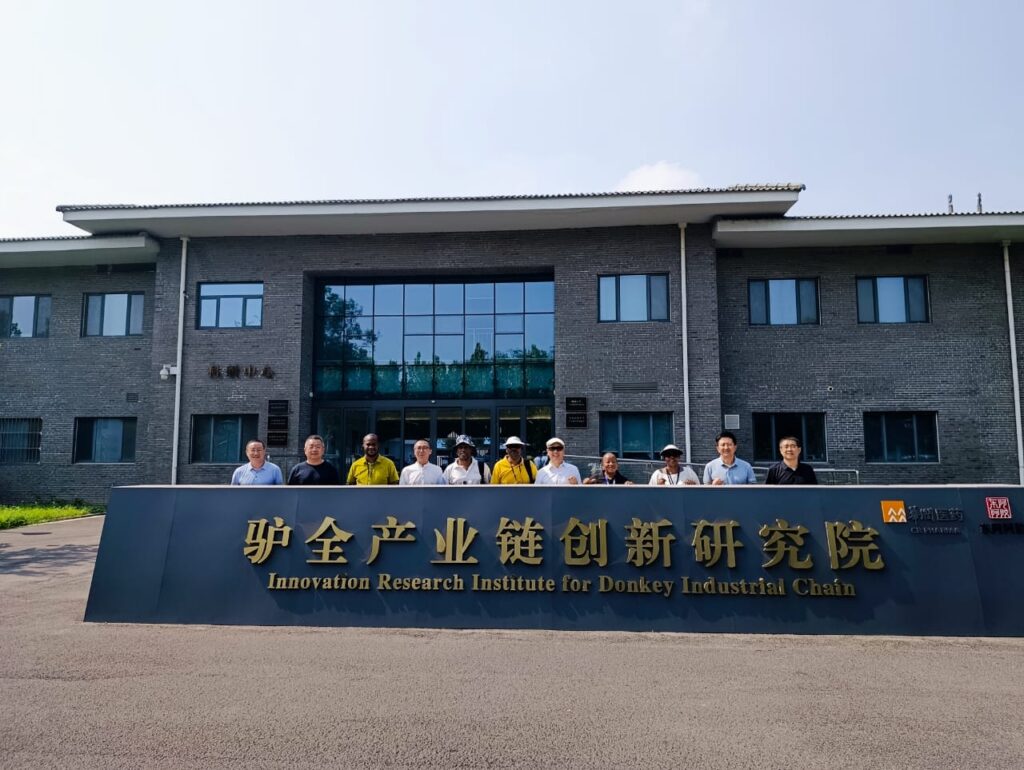
JINAN, CHINA — A Botswana delegation has visited donkey production and processing operations in China’s Shandong Province as the country explores opportunities to develop a sustainable donkey industry built around breeding, processing and value addition.
The visit formed part of Botswana’s investment promotion engagements in China, which have placed agriculture and agro-processing among sectors with potential to support economic diversification and rural employment.
Officials briefing the delegation explained that China’s donkey industry has developed beyond traditional livestock production to include scientific breeding, research, processing and the manufacture of several value-added products.
Shandong Province has one of China’s most developed donkey value chains, incorporating large-scale breeding, improved reproduction, meat processing, donkey milk products and the production of ejiao, a traditional Chinese medicine product manufactured from donkey-hide gelatin.
Officials noted that other products, including cosmetics, soaps and food products, have also been developed from different parts of the value chain.
The Botswana delegation indicated that the experience could provide useful lessons as the country seeks to derive greater economic value from livestock while creating opportunities for farmers and rural communities.
Botswana Presidential Envoy for Investment and Trade Affairs in the Asia-Pacific Region Mr Miles Nan has identified agriculture, processing and local manufacturing among areas where Botswana is seeking stronger investment and technology partnerships with Chinese enterprises.
The approach would require Botswana to move away from simply supplying raw animal products towards developing breeding programmes and processing industries capable of producing higher-value goods locally.
Botswana already has an emerging donkey milk industry. In April, the Botswana University of Agriculture and Natural Resources entered into a partnership with Donkey Milk Industries, trading as Secret Kalahari, to support research and development of the donkey dairy value chain, including cosmetics and wellness products.
The Shandong experience also highlights the importance of scientific breeding if a commercial donkey industry is to remain sustainable.
Any expansion of the sector would therefore require strong animal-welfare standards, traceability and controls to ensure that commercial demand does not result in the depletion of Botswana’s donkey population.
For Botswana, developing the entire value chain could create opportunities in farming, veterinary services, processing, research, cosmetics and export-oriented manufacturing.
The delegation’s engagement in Shandong forms part of wider efforts to identify Chinese technologies and investment models that can be adapted to Botswana’s agricultural and industrial development priorities.